History
Learn the history of the
"ASOCIACIÓN CULTURAL Y RECREATIVA LA BARQUETA"
DE BENIDORM.
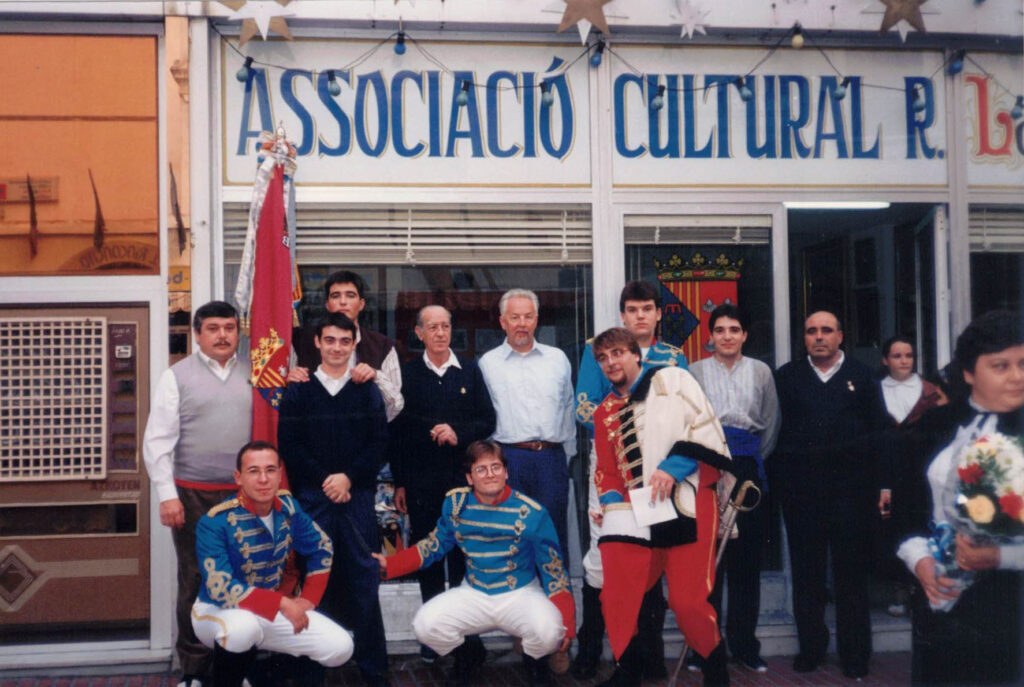
Among the associations of Benidorm, the La Barqueta Cultural and Recreational Association, ACR, is one of the oldest. Throughout the thirty-two years of its existence, it has occupied a very prominent place due to the quantity and nature of its activities.
An important member of the ACR la Barqueta was its founder José Bayona Vives (1911-2001). He was also its president from 1984 until 1995, when the presidency fell to Francisco Llorens Orts, who currently continues in office.
Foundation
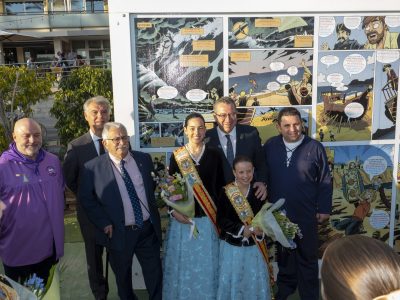
La Barqueta was founded in 1984 because a group of Benidorm citizens thought that they should not miss the staging of the discovery of the Virgen del Suffrage or Sofratge that had been carried out during the patron saint’s festivities since 1971, based on a text written by Pere Maria Orts i Bosch and a design of the london made by Rear Admiral Julio Guillén Tato. They wanted to prevent changes in the Festival Commission or the City Council from putting an end to an activity that, after thirteen years of uninterrupted celebration, was considered a very important element of the festival. The name of Barqueta referred to the aforementioned staging, which continues to be celebrated on Poniente beach every second Saturday in November at the beginning of the Patron Saint Festivals. The actors are members of La Barqueta
The influx of Benidorm residents and visitors grew steadily over the years and a consequence of its success was that in 2009 this staging of the arrival of the Virgin Mary was declared a “Festival of Provincial Tourist Interest” by the Generalitat Valenciana. Subsequently, in 2015 it was declared a Festival of Regional Tourist Interest.
The staging is celebrated in the month of November, but since the arrival of the image occurred in the month of March (03-16-1740), that day the event is commemorated with a procession in which an image of the Virgin is carried from the Barqueta headquarters to Paseo Colón, at the beginning of Poniente beach. It is the place where, according to tradition, the london carrying it to its stern was towed and the children found the image intact among the ashes.
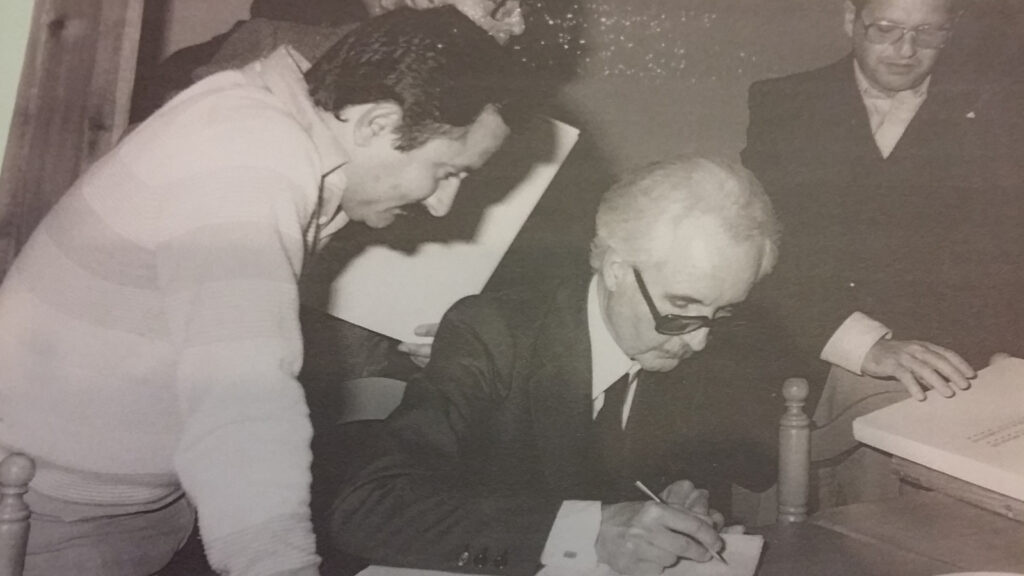
“Pere Mª. Orts asked José Bayona Vives, the President of La Barqueta, to play the role of his ancestor, Antonio Bayona, the owner of the lute. José Bayona played this role from 1971 to 1988 and his son Antonio Bayona has done it since 1988”
When it was established as an association, the first objective of staging the discovery of the Virgin of Suffrage was expanded because from that moment on it was intended to also be an instrument for the recovery of the local traditions. An important part of traditional customs were being lost due to changes in mentality and social habits introduced by tourism in the second half of the 20th century. It was about recovering certain activities that had characterized the life of Benidorm over the last centuries. The association’s goal was to recover it so that other entities would later maintain it. This was stated in its Statutes, presented to the Civil Government of Alicante for approval on December 18, 1984.
The name of Barqueta referred to the aforementioned staging, which continues to be celebrated on Poniente beach every second Saturday in November at the beginning of the Patron Saint Festivals.
An important member of the ACR la Barqueta was its founder José Bayona Vives (1911 -2001). He was also its president from 1984 until 1995, when the presidency fell to Francisco Llorens Orts, who currently continues in office.
Theatrical performance
In September of the year 1971 and by idea of the Commission of Major Patronal Festivals of that year, which was to stage the representation of the Finding of Our Patroness, a group of amateur actors from the square were used, who carried out said act, with text written by the Iltmo. Mr. Pere María Orts i Bosch. An act that has been carried out uninterruptedly since that year.
The text written by Pere Maria Orts i Bosch was published in 1972 in Valencia in a 28-page booklet with the title “Arribada d’una image de la Verge a Benidorm”. In 1997 the Tourist Board of the Alicante Provincial Council made another edition.
Pere Maria Orts i Bosch finds in the Simancas archive the documentation on the true history of the Virgin of Suffrage and then writes the text for its staging.
The actors are members of Barqueta.
From the first 26 actors, there are currently almost 70, including adults and children.
Pere Mª. Orts asked José Bayona Vives, the President of the Barqueta, to play the role of his ancestor, Antonio Bayona the owner of the lute. José Bayona played this role from 1971 to 1988 and his son Antonio Bayona has done it since 1988.
The influx of Benidorm residents and visitors grew steadily over the years and a consequence of its success was that in 2009 this staging of the arrival of the Virgin Mary was declared a “Festival of Provincial Tourist Interest” by the Generalitat Valenciana. Subsequently, in 2015 it was declared a Festival of Regional Tourist Interest.
Last year, 2023, given the large influx of people, the Festival Commission heard two old requests from La Barqueta and carried them out. They install screens in the Elche park so that more people can see the discovery live, a thunderous bonfire of fires at the appearance of the virgin.
The staging is celebrated in the month of November, but since the arrival of the image occurred in the month of March (03-16-1740), that day the event is commemorated with a procession in which an image of the Virgin is carried from the Barqueta headquarters to Paseo Colón, at the beginning of Poniente beach. It is the place where, according to tradition, the london carrying it to its stern was towed and the children found the image intact among the ashes.
The sound of the Hallazgo was already old, it was poorly appreciated and given the impossibility of recording again, it was decided to remaster and clean it. Work done.
The discovery had been underway for 20 years with the intention of covering the park wall with a large mural that represented more houses, a mural created by Miguel Ribes Sogord, to give more depth.
Activities
March 16
That dawn on the memorable day of March 16, 1740, that felucca owned by Antonio Bayona, skippered by himself, and crewed by Vicente Llorca de Marcos and Miguel Llorca de Francisco, with others that the documents do not mention, arrived at the Benidorm cove. It could have been a dawn like any other in which, as so many times, some sailors risked their lives.
But it was not like that, because the high designs of Providence made use of those men and some fairly common circumstances, with the intervention of the Navy Judge Francisco Orts and the horse captain José del Corral so that that dawn had a special meaning for Benidorm, all of which the notary Alvaro Llorca would attest to.
A dawn, a beginning of a new day that, for our Villa, came to represent the beginning of the first page of one of the most endearing events in our history: the arrival of an old london and the discovery of the carving of our exalted Patroness.
Many sunrises have followed one another since then, some mournful, others joyful, but none so memorable in which a felucca, with its lateen sail unfurled, helped in its propulsion by the oars vigorously wielded by its crew members who, without knowing it, were bearers of our most precious treasure.
Theater
Among the activities recovered by La Barqueta we must first highlight the farce theater group. Theatrical performances as a form of leisure had been deeply rooted in our lands during the 19th century and part of the 20th, as demonstrated by the large number of popular works that are preserved. These were works written in Spanish but also in popular Valencian, not at all careful and full of Castilianisms, but which enjoyed great acceptance among the people for their comedy. Normally the actors were not professionals but the townspeople themselves and this aspect is what La Barqueta wanted to recover. It represented popular works, mostly comic, with actors who were members of the association. Its most important activity occurred during the first years (1984-1986) and some of the most represented works and with the most popular acceptance were Nelo Bacora, El fulano de la concha, and De sacristà a torer, represented in various places: Aula de Cultura of the CAM and even on the street.
President José Bayona was also the author of some works of this type:
“He is the author of a considerable series of skits in Valencian, most of them performed by the amateur actors of the La Barqueta theater group. Among these simple comic works, which contain all the usual ingredients of the genre, we must mention: El sord de la platja (1971), El fadrí (1973) – written on the occasion of the wedding of his friend Roc Fuster -, Pobre però honort (1981). —focused on the experiences of a married couple facing the topic of money—, Vixca la vida (1982) —which develops the theme of the effects of modernity on a man who returns to Benidorm after having lived abroad for a long time—, El prometatge (1982), El transplantament (1982), El tonto del poble (1982), Parell de parelles (1984), Tot per la bellesa (1984) and Sableta (1985)”
In January 1987, the children’s theater group was organized and debuted with the play Campanas de Belén, a representation of the Birth.
Later, the barqueta theater group disappeared due to lack of actors, and some entered the Benidorm club theater, which also disappeared today.
Although other entities have continued theatrical performances, the specialization in popular Valencian works has not been maintained.
"Corpus"
Another traditional activity in our community has been the Corpus Christi procession. In Benidorm, La Barqueta recovered in 1985 the tradition of the “paraes” or altars where the procession stopped and the Blessed Sacrament was exposed.
Traditionally there were three along the route that went through Mayor, Alameda, Paseo de la Carretera and Santa Faz streets. The first stop recovered was the Plaza de la Cruz, which was decorated with an artistic dyed sawdust carpet with various representations.
Later, others were installed on Paseo de la Carretera street and on Santa Faz street.
Today the three parradas continue but decorated with flowers
Conferences
In March 1986, the first cycle of conferences began with speeches by Jaume Pérez Zaragoza on the almadraba, by Rafael Alemany Ferrer on the Carta Puebla de Benidorm granted by Bernat de Sarriá, by Pedro Zaragoza Orts on tourism, etc.
Also, in the same year 1986, a children’s choir was created that performed in the Corpus Christi processions, the Church of San Jaime, the Hermitage of Sanç and even at neighborhood festivals and in some neighboring towns.
Drawing Contest
To disseminate among children the events of the arrival of the Virgin of Suffrage to Benidorm, La Barqueta organized a writing contest in 1987, which has been continued by the Patron Saint Festivals Commission.
Since 2002, Barqueta has organized a School Drawing and Painting Contest about the discovery of the Virgin. In 2016, more than 1,400 children between 6 and 12 years old from all schools in Benidorm participated. The prizes are awarded according to age groups and are financed by the Benidorm City Council, the Alicante Provincial Council and several collaborating companies.

City foundation letter
On May 8, 1988, the granting of the Puebla Charter of Bernat de Sarriá was staged, without continuity in subsequent years. Since 1992, it is the Association of Peñas Virgen del Sufragio that has institutionalized the event celebrating the founding of Benidorm.
"Rondalla"
That same year Barqueta created a pulse and púa rondalla directed by Francesc Pérez Lapera and made up mainly of bandurrias, a very common musical instrument in other times. Its repertoire is made up of mostly popular works, although it also includes classical works. The first performance took place on December 23, 1986. At its best it had 32 musicians and a good number of students, but currently they have been reduced. Since 2000, it has participated in an agreement with the Provincial Council of Alicante and the Federation of Rondallas where 28 rondallas of Alicante collaborate. The members are obliged to act in another town and to receive visits from the rondallas of other municipalities such as Campello, Villajoyosa, Alcoy, Sella, San Juan, etc. Currently the director of the rondallala is Josep Vives y Lloret and he continues to be very active.
Nativity scene
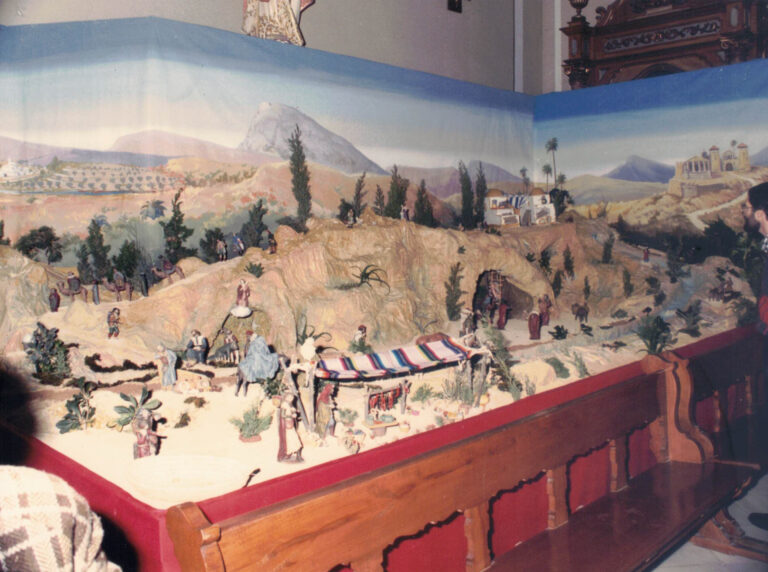
A popular tradition also deeply rooted in our lands was that of nativity scenes. So that it would not be lost, La Barqueta organized its nativity scene for the first time in 1987 in the church of San Jaime. After a few years, the limitations that the worship schedule imposed on visitors made it advisable to change location. It was first set up at the association’s headquarters, in the Municipal Market, but space problems advised the subsequent transfer to the premises on Tomàs Ortuño street where, for years, it has received thousands of visits from Benidorms and tourists. Currently, he continues to set up a nativity scene in the church of San Jaime and a living nativity scene in the parade of the Three Wise Men festival that closes Christmas.
Blessed Sacrament
In 1997, La Barqueta celebrated the third centenary of the reservation of the Blessed Sacrament in the church of San Jaime. For this reason, he published a booklet with the collaboration of the Benidorm City Council which, in addition to the program of events from August 20 to 25, included historical studies on Benidorm and the Eucharist and the transcriptions of two very interesting documents for the religious history of Benidorm. The first dates from 8-25-1697, is found on folio 4 of the Baptism Book of the parish of San Jaime and records how on that day the reservation of the Sacrament was made in the church thirty-one years after the new founding of Benidorm by Beatriu Fajardo. The second is a slightly older document, from November 30, 1690, which tells us that the town requested permission to establish a chaplaincy in the church of San Jaime, which proves that twenty-four years after its foundation the number of inhabitants of Benidorm had increased so much that the parish priest of Polop could not adequately care for them and needed the help of a priest.
A commemorative medal was also issued. On one side it represented the Island of Benidorm on the sea and the cross of Saint James on the sky with the inscription A.C.R. La Barqueta Benidorm 08-25-97. On the other side, a monstrance with the inscription III Centenario Reserva del Santisimo Sacramento 1697-1997.
Exhibitions
Another important activity of La Barqueta has been the organization of very diverse exhibitions on an annual basis. We must highlight the exhibitions on boys and girls of first communion, traditional festivals, ladies and queens of the patron saint festivals, weddings before 1975, etc. It is also worth noting the exhibition held in October 2015 at the Casa del Fester. With the title “History and tradition of Benidorm” elements that illustrated traditions and customs of Benidorm were exhibited, including two paintings by the artist Miguel Ribes Segorbe representing traditional crafts. It had a section dedicated to Pere Maria Orts i Bosch who had died that year. It was a way of recognizing his merit for having found in the Simancas archive the documentation on the true history of the Virgin of Suffrage and for having written the text for its staging.
Sant James, July 25
Despite being the patron saint of the town since time immemorial. The oldest reference to the cult of San Jaime in Benidorm is in a document from the 15th century (09/13/1414). It tells us that in the castle of Benidorm there was a chapel dedicated to Saint James and that on his feast day a mass was celebrated:
“Anno a nativitate Domini mccccxiiii die jovis intitulata xiii septembris. Visitio ecclesie basilice loci de Benidorm sufraganea ecclesie loci de Polop. […] Castrum de Benidorm. In castro de Benidorm est capella sancti Jacobi et altare at retrotabulum erecta sed altare erat nudum et nulla sunt ibi ornamenta sed Miqael Ramirez subalcaydus dixit quod die sancti Jacobi paratur altare et ibi celebratur.”,
The festival of Saint James, celebrated on July 25, had lost importance. La Barqueta set out to recover it, especially the procession, and achieved it in 1987. The Patron Saint Festival Commission now continues the aforementioned celebration and one of its activities takes place on July 25 when a parade of xirimiters and tabaleters with the Benidorm Musical Union goes to the headquarters of La Barqueta where the image of the saint is collected and taken to the Plaza del Torrejó.
Other Activities
Another important activity of La Barqueta has been the organization of very diverse exhibitions on an annual basis. We must highlight the exhibitions on boys and girls of first communion, traditional festivals, ladies and queens of the patron saint festivals, weddings before 1975, etc. mili, nativity scenes
It is also worth noting the exhibition held in October 2015 at the Casa del Fester. With the title “History and tradition of Benidorm” elements that illustrated traditions and customs of Benidorm were exhibited, including two paintings by the artist Miguel Ribes Segorbe representing traditional crafts.
It had a section dedicated to Pere Maria Orts i Bosch who had died that year. It was a way of recognizing his merit for having found in the Simancas archive the documentation on the true history of the Virgin of Suffrage and for having written the text for its staging.
Not all were successes
La Barqueta has not always been successful in its work of recovering elements of the tradition and culture of Benidorm. In 1985 he tried to recover the traditional children’s game of hoops, but it has not been able to continue. Their mobilizations during the years 1986 and 1987 to prevent the urbanization of Tossal de la Cala were of no use either. It acted together with other elements of the cultural and political life of Benidorm, but finally the site was not respected and urban development interests predominated with the destruction of the entrance to the “castellum” and the construction of a swimming pool at the highest part of Tossal, destroying archaeological remains.
For this reason, in 1986, when the Barqueta location on La Palma Street was inaugurated, no representative of the municipal corporation attended the event.

The first eight years were very active for the association. Subsequently, she had two years in which it seemed that her enthusiasm had waned and her activities had diminished, but she overcame this and is currently still very active.
It retains a significant number of partners, more than 250, the contribution of which is usually limited to that contribution. As happens in most associations, those who really work are fewer. Its financing comes, in addition to member fees, from the sale of lottery and the sale of products to the October 9 fair with a “paraeta” provided by the Festival Commission.
Our meeting places
The first social premises of the ACR La Barqueta was a basement on La Palma street donated by Gregori Aznar Llorca. The address that appears in the statutes has never been its headquarters.
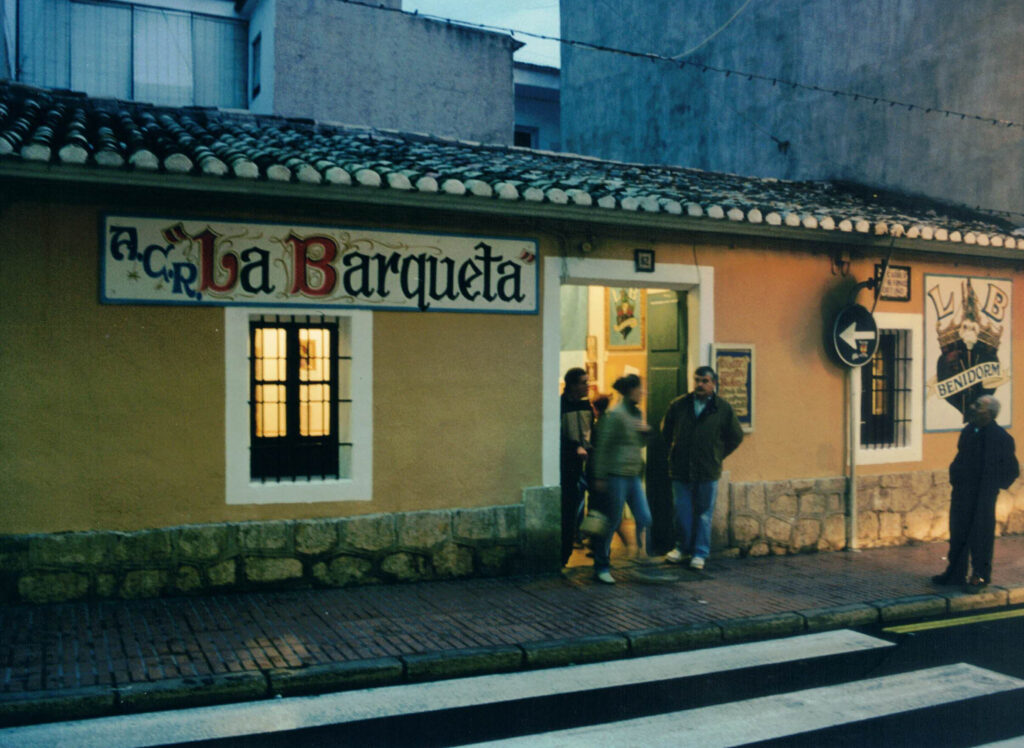
Later it had two premises of the Municipal Market donated by the City Council and the Puchades family on October 28, 1988. The subsequent transformation of that Market building forced them to move to the current premises at 62 Tomàs Ortuño Street, an old house that preserves its traditional structure and which was donated free of charge by the Pérez-Aguilar family. In it they set up the nativity scene and some exhibitions.
AND IT SERVES ANY ASSOCIATION TO HAVE THEIR OWN EXHIBITIONS AND SELL OBJECTS.

Distinctions
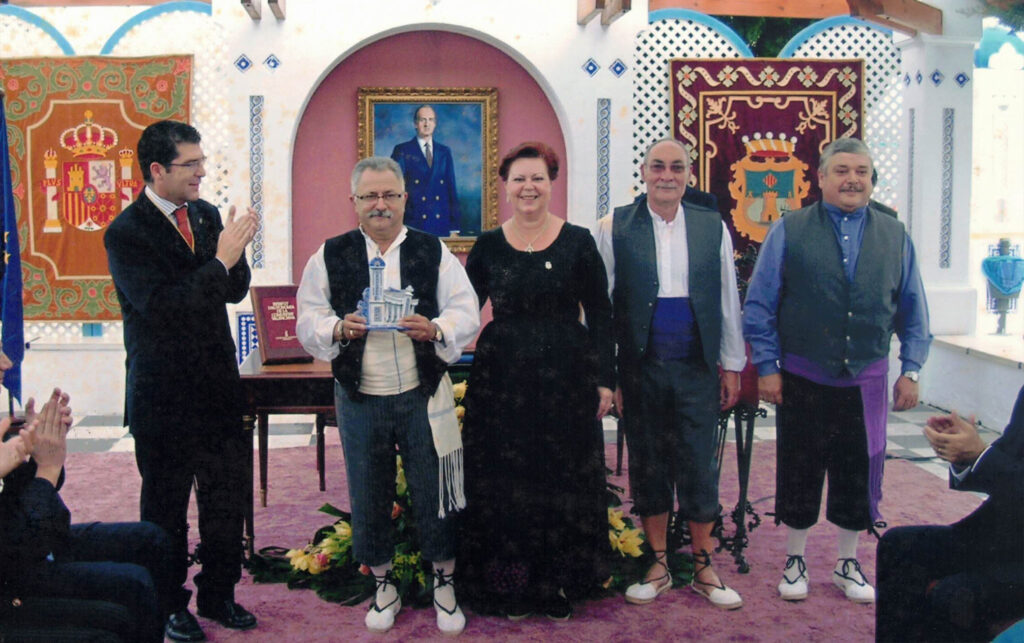
For its continued task of preserving and disseminating traditional culture, an intangible heritage of great value, the debt of gratitude that the city of Benidorm owes to the ACR la Barqueta is great. This was recognized when in 2006 the City Council created the “City of Benidorm Cultural Distinction” and she was the first to be awarded for her accredited and outstanding activity in the field of local culture and its dissemination.